
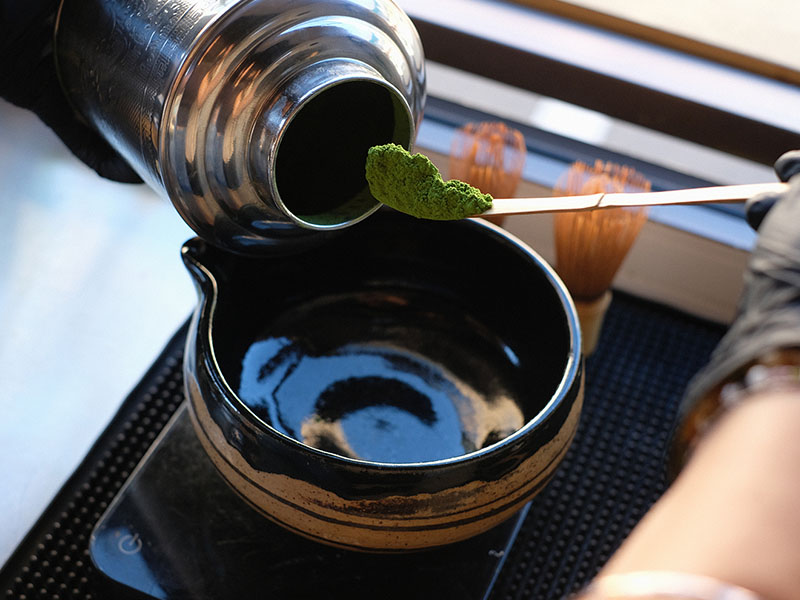
Tiny Café, San Luis Obispo pop-up café and caterer, serves freshly ground matcha sourced from Uji in Kyoto, Japan: the birthplace of Japanese tea culture. Following the practices of a Japanese tea ceremony, Tiny Café is helping drinkers understand what goes into a proper cup of matcha, while introducing the Central Coast to the traditions and rituals behind it.
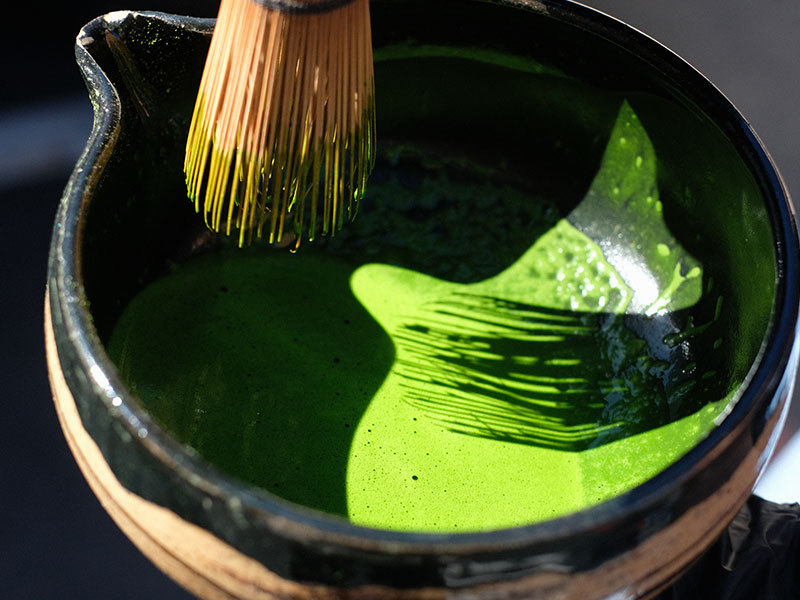
Here, they spill the tea facts to make us all educated consumers.
- The Japanese tea ceremony known as sadō grew out of a 12th-century practice of Zen Buddhism. Later it was guided by four principles: Wa (和) harmony, Kei (敬) respect, Sei (清) purity, and Jaku (寂) tranquility.
- Matcha is finely ground green tea leaves that are whisked into water and brewed at 160 degrees F to 175 degrees F.
- Traditional stone mills can grind only about 40g of matcha per hour, and that speed cannot be pushed without sacrificing quality; friction generates heat, and heat deteriorates matcha’s delicate qualities. The enormous effort this requires is reflected in its value. Because matcha begins to change in quality the moment it’s milled, freshness matters as much as origin.
- When preparing, never use boiling water (212 degrees F); Hot water can scorch the tea, resulting in harsh bitterness.
- The term ceremonial matcha, while not typically used in Japan, has become a helpful shorthand for consumers navigating a category where prices vary widely. What we consider high-grade matcha is shade-grown green tea. The shading process boosts chlorophyll, giving the leaves their vivid green color.
- When ordering, first harvest matcha does not necessarily mean ceremonial matcha. First harvest describes when the leaves are plucked. It is made from the youngest leaves picked each season and is prized for its natural sweetness and mild flavor, while later harvests offer a bolder, more robust effect.
A mobile business that changes locations, Tiny Café is currently found at:
496 Broad Street in San Luis Obispo.