
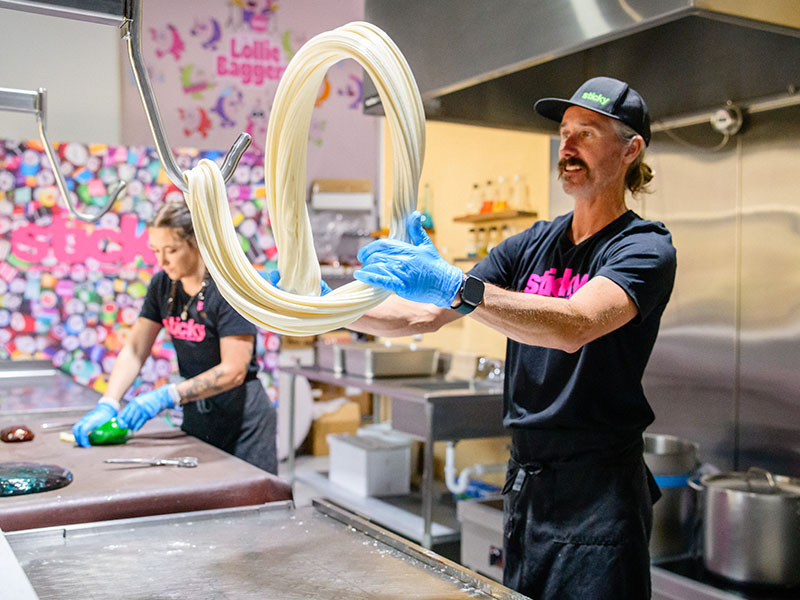
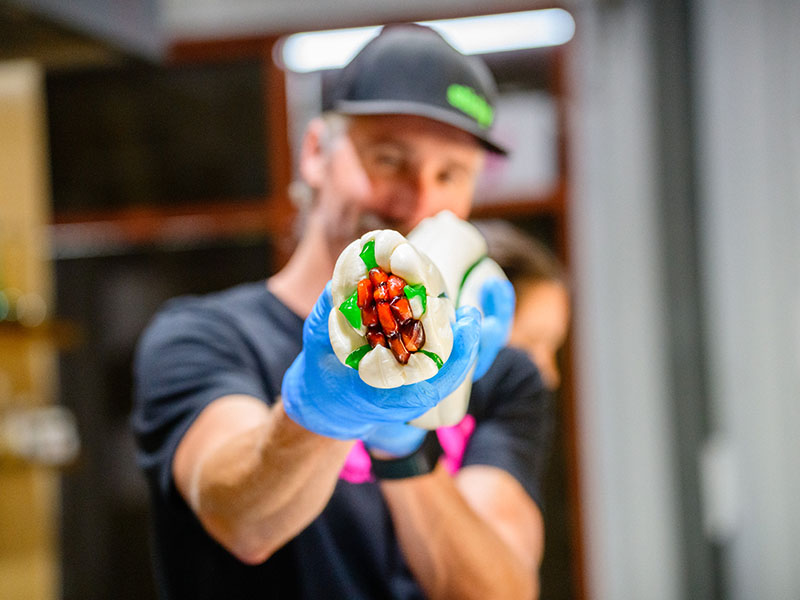
A Sticky candymaker at work displays part craftsmanship, part performance. Molten sugar is stretched, folded and assembled by hand before being pulled into long ropes and sliced into hundreds of identical pieces. A piece of fruit, a company logo or even a phrase is built inside the candy long before it’s revealed in the finished product.
The technique has existed for centuries, but relatively few confectioners still practice it by hand. It demands scientific precision and refined instinct, a process Craig Montgomery knew nothing about when he responded to an unexpected phone call in 2011. He was living in his hometown of Paso Robles after selling his share of a digital printing business, and was teaching himself computer programming, when a former employee and friend, Matt Fosburg, called with an unusual opportunity: Australian candymaker David King was looking for someone to learn the production methods of his company, Sticky, to help launch the brand’s first U.S. location.
“I looked at the website and thought, ‘Yeah, that seems weird, but cool,’” Craig says, jovially. “Honestly, I was most excited about going to Australia.” At the time, Sticky operated a single shop in Sydney’s famous The Rocks district. The company had expansion plans and Los Angeles developer Gary Shafner envisioned Sticky as the star of a 30,000-square-foot candy destination on Hollywood Boulevard.
Craig first met with Gary at his office, accessed through the front half of a Greyhound bus. Inside, the building resembled a miniature city, complete with storefront façades and themed offices. “It just kept getting more bizarre,” he remembers. “The whole place was built around visual puns.” The whimsical headquarters offered an early glimpse of the imagination behind the Hollywood candy destination Gary hoped to build.
From there Craig flew to Sydney, where he trained for six weeks, learning every stage of handmade hard candy production, beginning with simple fruit art. Each batch had to be cooked, colored, assembled, stretched and cut within a narrow window of time before the candy hardened. “As the candy changes temperature, it changes completely,” Craig explains. “If you’re not careful about how you move one part of it, the whole design shifts.”
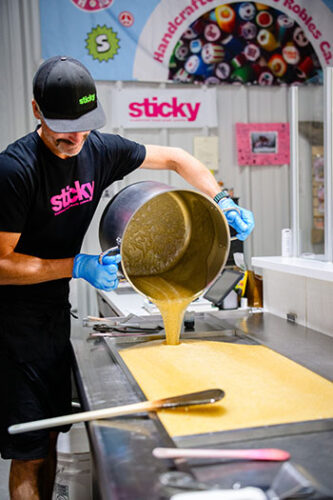 The process required technical skill, though he soon realized it also depended on instinct: an understanding that only came through repetition. “It was a crash course. One day you’re making apples. Then you’re making letters. Then you’re trying to build words inside the candy…. I found myself coming in on my days off just to watch people make candy,” he says.
Upon returning to California, the Hollywood project was still under construction. Rather than idly waiting for the delayed opening, Craig jumped in where needed, installing equipment, building retail fixtures and preparing the candy kitchen for inspections. By opening day, he understood nearly every aspect.
Sticky became the centerpiece of the elaborate confectionery attraction where visitors watched candy being made throughout the day. Over the next several years, Craig experimented with increasingly complex designs, gained a deep understanding of the science behind the process, and developed skills that would eventually make him Sticky’s most trusted trainer. As the company expanded internationally, David sent Craig abroad to train new teams, first in Mexico City and later in Abu Dhabi. In 2018, David offered Craig a licensing agreement for the American market.
Craig used that opportunity to return to the Central Coast and began building the business on a shoestring budget. The pandemic shutdowns suddenly left Craig with equipment, inventory and time — but no storefront. He built a Shopify website and began selling candy online, hoping orders would trickle in. Business exploded. After a Sticky Australia’s Facebook Live video mentioned his new website, Craig’s phone erupted with Shopify notifications. “Before that, I’d get two orders a day and think, ‘That’s exciting,’” Craig recalls. “But then it was cha-ching, cha-ching, cha-ching. It just wouldn’t stop.”
It was all great, until it became a problem. “I realized I hadn’t turned off the option to keep selling after products sold out. People bought everything. Even candy I didn’t have.” With hundreds of orders to fill, Craig scrambled to rent a commercial kitchen and called up Matt. The pair spent every weekend producing as much candy as they could. He also recruited his brother to learn candymaking, packaged orders at home and shipped them from the Paso Robles post office. Rather than trying to keep inventory in stock, he began releasing new batches at a scheduled time each week.
At first, the candy sold out in about an hour. Then 30 minutes. Eventually, everything was gone in less than 10 minutes. Social media helped fuel demand, but Craig believes people were responding to something deeper than the candy itself.
“They wanted to know who was making it,” he says. “They followed the candymakers, our stories and the process. They felt connected to it.” That connection remains central to the appeal. Customers aren’t simply buying candy; they’re watching it being made and learning about the craft behind it.
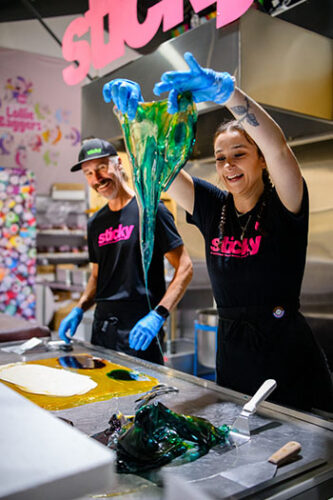 A call with the late Mike English, a local property owner, led Craig to set up shop in Tin City Annex in Paso Robles. Today, that same workshop serves as Sticky’s American outpost, where visitors can watch the candymaking process unfold in real life, just as Craig first did in Sydney more than a decade ago. They now produce about 400 pounds a week, ship over 500 retail orders a month, and also have a booming custom order business that ships nationwide.
“Mike was another person who heard my story and believed in what I was trying to do,” Craig reminisces. Looking back, he sees a career shaped not only by unexpected opportunities but by people who recognized his dedication and chose to invest in him.
More than a decade after that first trip to Australia, Craig continues to produce candy the same way he learned it: by hand, in full view of customers. The techniques haven’t changed much. Neither has the approach that first carried him halfway around the world: staying curious, saying yes to unexpected opportunities and building on a rare but inspiring tradition.