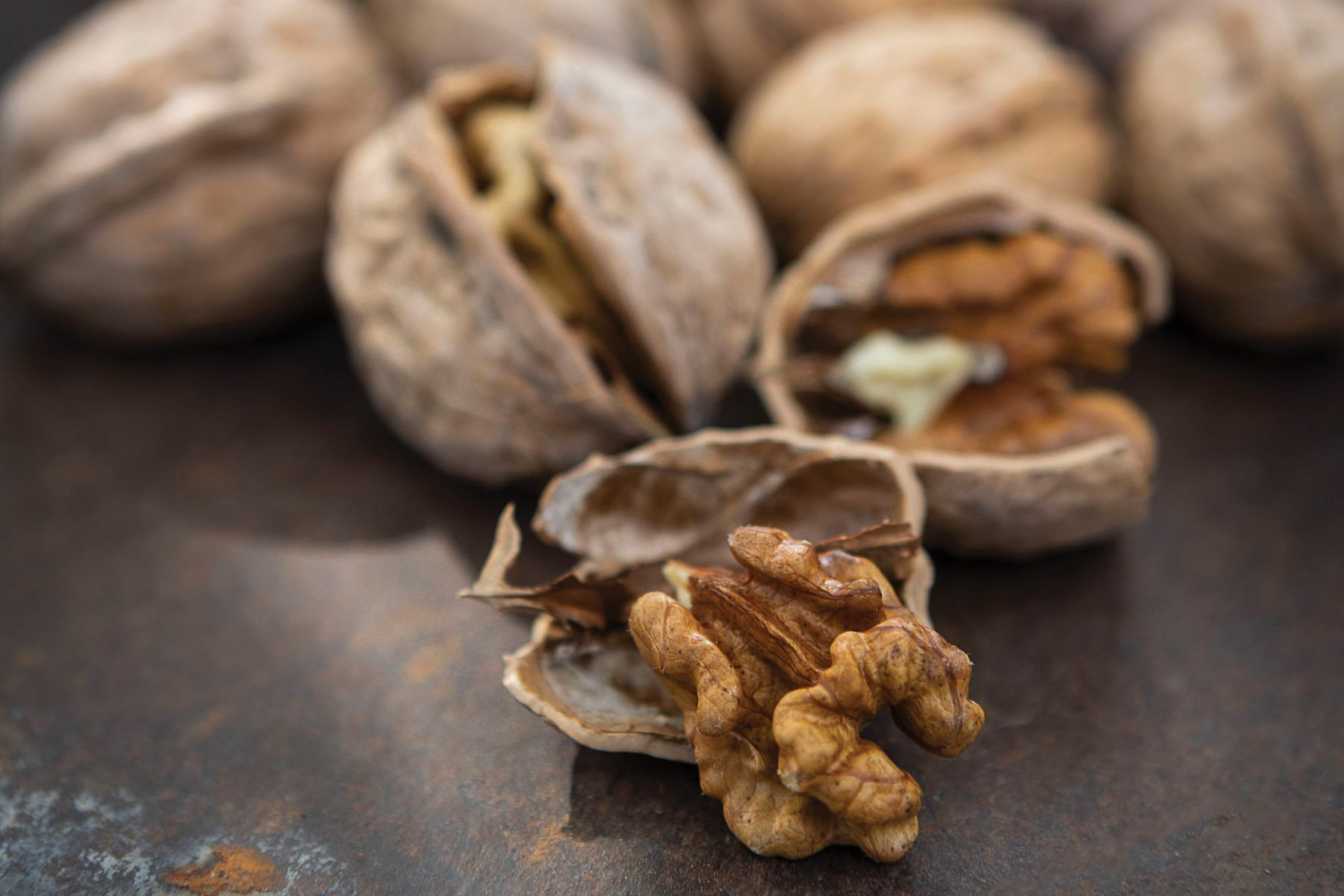
Ripe walnuts just harvested from the tree. The distinctive furrowed brown shell protects the edible nutmeat inside.

Walnut Harvest at Fair Oaks Ranch

Story by Katy Budge

Photography by Gennan Shippen

For most of us, walnuts are conveniently found in plastic bags on grocery shelves. But harvesting these tree nuts is a complicated process, especially when done in the time-honored way practiced at Fair Oaks Ranch in Paso Robles.

Rooted in History

Owned by Coco Collelmo and Sue Bowles, Fair Oaks Ranch gently sprawls over 735 bucolic acres in the Adelaida Hills. The property has been in Coco’s family for over 60 years, and its vistas evoke a timeless image of California rangeland. Hawks and turkey vultures swoop and swirl in the sky, while grazing cattle share the rolling landscape with deer, foxes, bobcats and even the occasional mountain lion.

There are also about 45 acres of majestic dry-farmed walnut trees, which were planted by Coco’s father soon after the family bought the ranch in 1959. He chose the Franquette variety because “of its ability to produce every year instead of intermittently,” says Coco. “And because their shells stay tighter, they stay fresh longer after harvesting compared to other walnuts.”

“There’s nothing like the taste of these right out of the orchard,” Sue adds, noting that the flavor is due in part to a lower tannin content in Franquettes. Tannin is a slightly bitter, astringent substance particularly associated with red wine. In walnuts, it’s mainly in the papery skin surrounding the nutmeat.

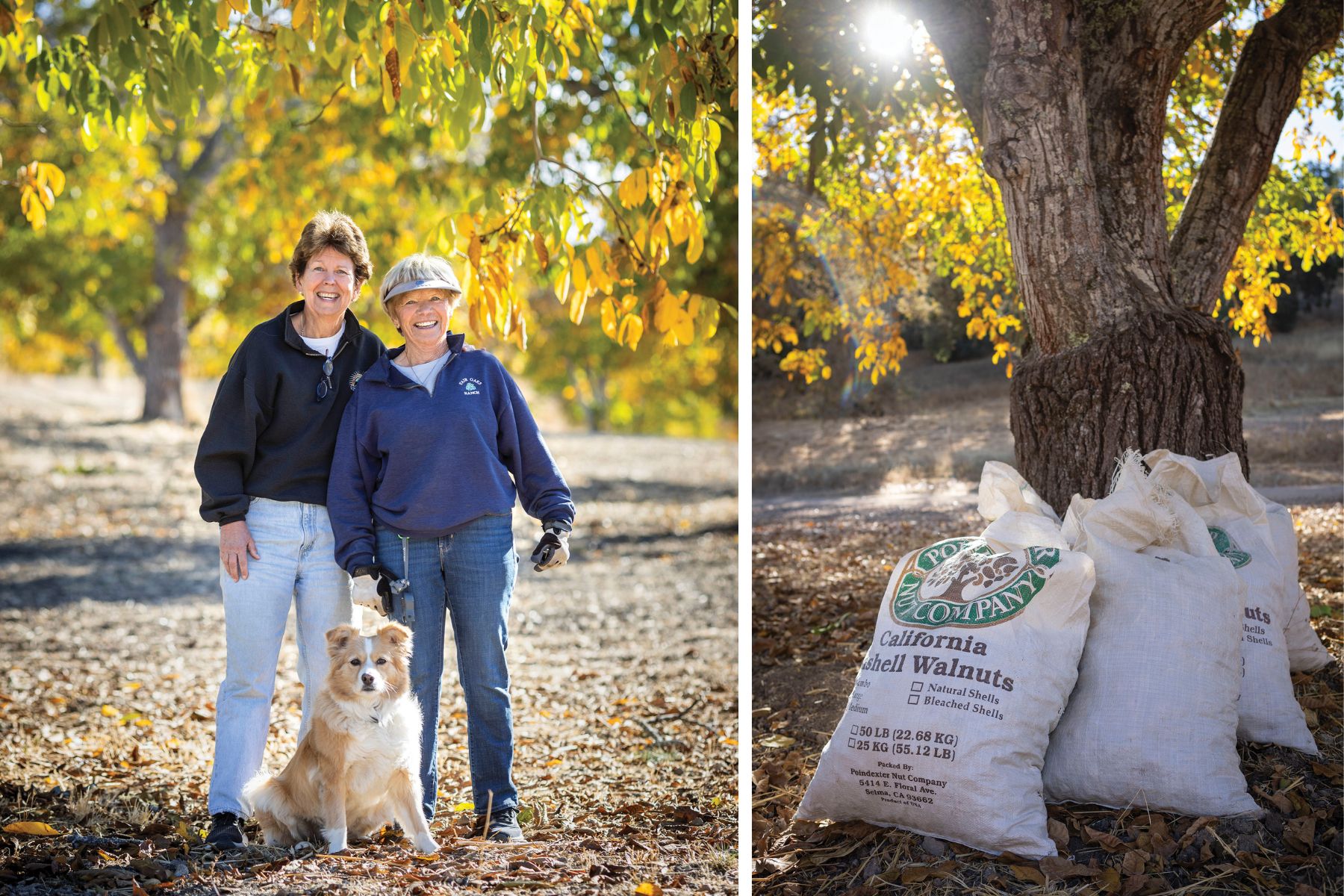
Fair Oaks Ranch Owners
Fair Oaks Ranch Owners Sue Bowles (left) and Coco Collelmo (right), with Callie, their Border-Aussie crossed dog; sacks of harvested walnuts propped at the base of the trees to be collected for hulling and drying.
Quality Over Quantity

Franquettes are a French variety that date back to the early 1800s, according to website of Trees of Antiquity, an heirloom fruit and nut nursery located in Paso Robles. It also states that the “Franquette walnut [was] once the dominant walnut planted through the West.”

California grows almost all of the walnuts for domestic consumption, and produces over 60 percent of the global crop. However, these days most aren’t heirloom varieties such as Franquettes, and most certainly are not grown and harvested as they are at Fair Oaks Ranch.

As with many crops, heirloom walnuts have been pushed out of widespread commercial plantings in favor of those with bigger yields that can be brought to market faster. Varieties such as Chandler, Ivanhoe and Tulare now rule the roost, and most are grown in the fertile fields of the San Joaquin Valley.

But those trees are all irrigated, explains Coco. And they’re planted and pruned in such a way that they can be easily machine-harvested. Contrast that with the approach of Fair Oaks Ranch: entirely dry-farmed and hand-harvested.

Yes. Harvested by hand.

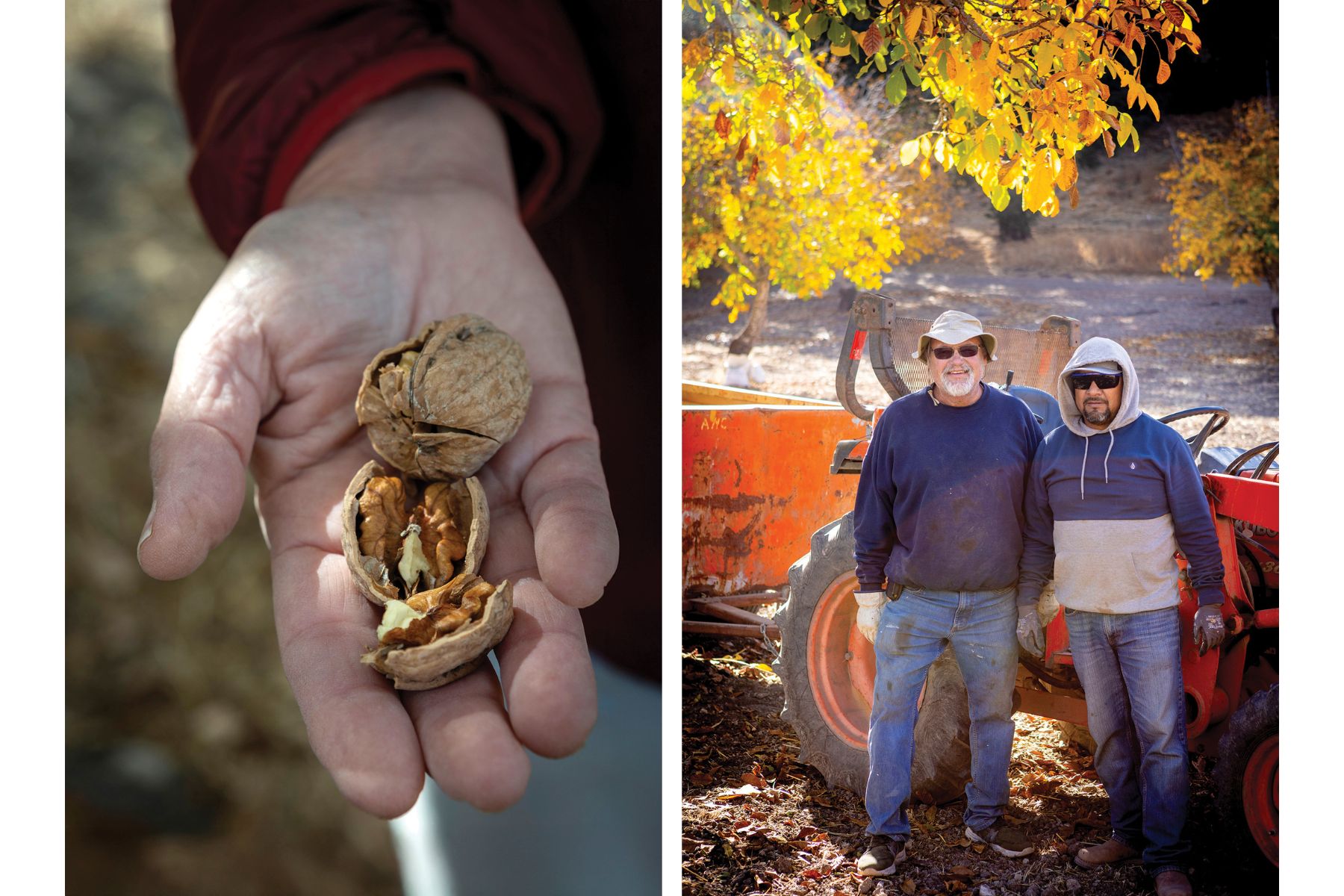
Walnut shell opened, two team members
When opened, the shell reveals two nut halves with bumpy symmetrical segments that create a winged, butterfly shape. The team puts in extra hours during November's harvest season.
A Personal Touch

As November looms on the calendar, Coco and Sue start watching the weather reports for rain.

“The walnuts might be ready to harvest, but they will not come down or crack for release until we have a heavy fog or a slight to moderate rain,” Coco explains. “Moisture will start the harvest.”

Note that nothing has been said about “picking” the walnuts. Though they do indeed grow on trees, most of us would walk right past a ready-to-harvest walnut tree and not even know it. Like other tree nuts, walnuts are a bit of a Russian nesting doll. There’s a thick green outer hull that encases the shell, which encases the nut itself.

“When the weather changes and provides moisture, the outside hull cracks open,” Coco says. A shaker machine is then used to shower the walnuts to the ground.

“We hire 20–25 pickers to pick the crop up off the ground by hand, put it into three- to five-gallon buckets, and then into walnut sacks for transport,” she says. “A semitruck is loaded over two or so days, then shipped to the San Joaquin Valley to Poindexter Nut Company. They purchase our crop once we pay for hulling and drying at their facility.”

To say this is labor-intensive is an understatement, and that’s reflected in the final tally sheet for the Fair Oaks’ walnuts.

“Labor is expensive, and can be extremely difficult to find,” Coco says. And because walnuts are a valued crop both domestically and worldwide, growers are subject to the vagaries of weather, tariffs, supply chain disruption and fluctuating crop prices. Given all those challenges, Coco and Sue won’t even know the final per-pound price they’ll be paid until the financial dust settles in the spring.

“Walnuts are certainly a commodity crop,” Sue says. As a result, “growing them is often not even a break-even deal, and in some years people have dumped their crop or pulled out their trees entirely.”

So why do Coco and Sue keep at it? Certainly part of it is to retain the rich agricultural tradition of their beloved Fair Oaks Ranch. But, as Sue points out, “as long as we can break even by paying people an honest wage to work, then we’re able to provide the community a healthy and delicious food.”