A Garden Without Borders at Our Global Family Farm in San Luis Obispo
Story by Sonia Fiorenza
Photography by Gennan Shippen
Our Global Family Farm at City Farm SLO is a community hub for volunteers, students and organizers. Writer Sonia Fiorenza takes readers to the farm where permaculture is practiced.
“Let’s water all of Europe today,” says Teresa “Tree” Lees on a recent Sunday at Our Global Family Farm, a quarter-acre garden plot at City Farm SLO. It’s a profound statement made with surprising casualness.
Here’s why: Tree has organized the farm around the four corners of the world — Europe, Asia, Africa and the Americas — with each area growing plants indigenous to that region. In the Europe section, leeks, artichokes and arugula thrive side by side. Nearby, the Asia garden is planted with peaches, bok choy, peppers and basil. “People think basil comes from Italy,” says Tree, “but it was indigenous to Asia.”
The Americas section honors Indigenous cultures through the food that grows there. “Mexican, Mayan, Aztec, Alaskan — these are all Indigenous people of the Americas, and we celebrate their diversity through the food we grow,” she says. In spring and summer, the beds fill with corn, beans, squash, tomatoes and potatoes — crops native to these continents. “It’s easy to think potatoes come from Ireland, but they’re native to Peru, so we plant them here.”
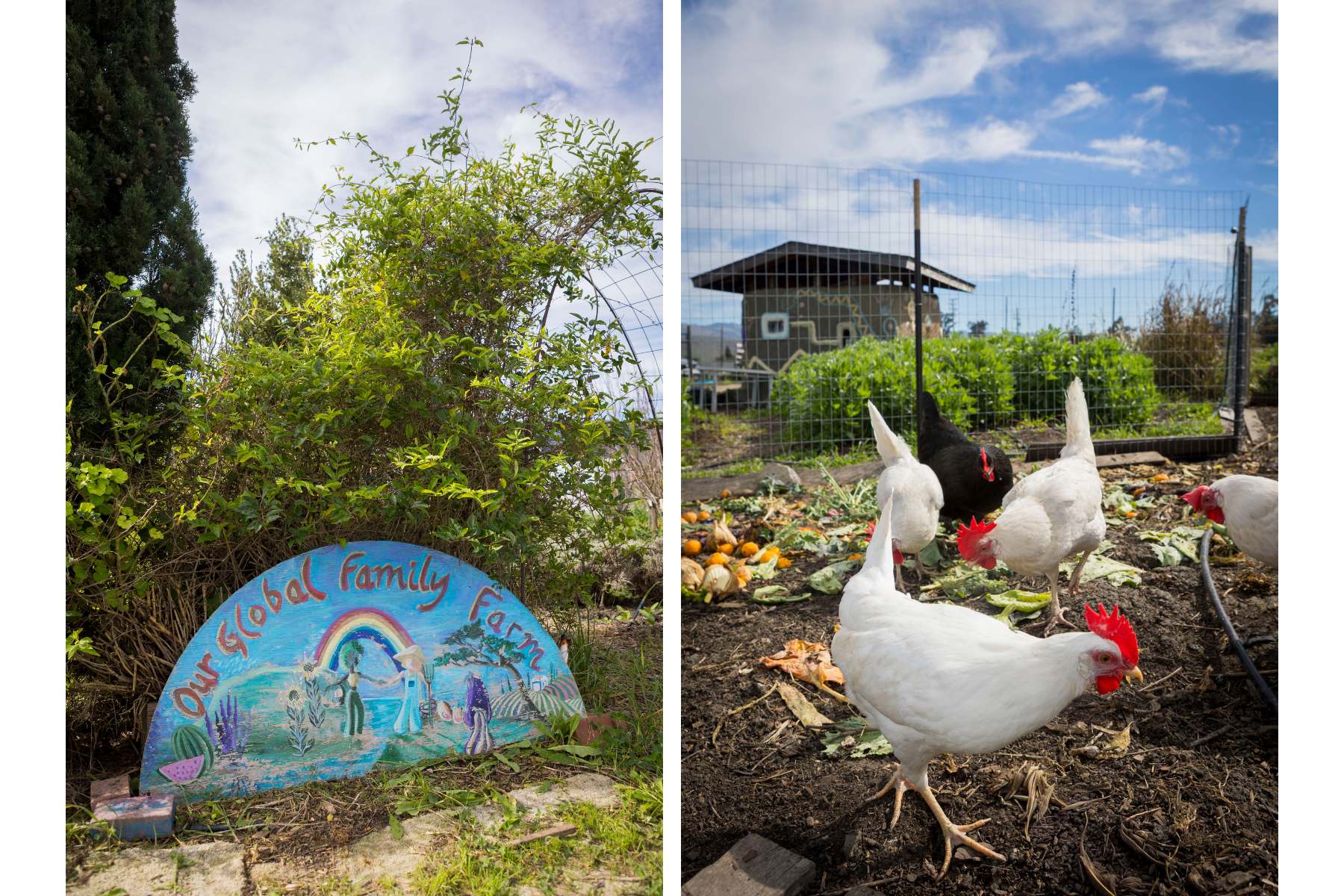
Our Global Family Farm in San Luis Obispo fosters global unity through permaculture, growing international crops.
In addition to crops, there’s also a mud hut in the Africa section. Made of heavy clay soil, sand, straw and water, it’s intended to show natural building techniques used for housing in other parts of the world.
A lifelong educator, Tree has dedicated her career to helping people, especially children, build relationships with food, plants and the natural world. She spent a decade as education coordinator at the San Luis Obispo Botanical Garden and later worked with One Cool Earth, bringing garden-based learning into local schools. In 2014, she established Our Global Family Farm at City Farm SLO as a children’s garden rooted in permaculture principles — a place where kids could explore, learn where food comes from and have fun doing it.
“The thing kids do most when they come out here is run around on the little pathways,” Tree says. “That’s why I designed it this way, instead of straight rows. It creates a place for play and curiosity, a combination of a playground and a farm together.”
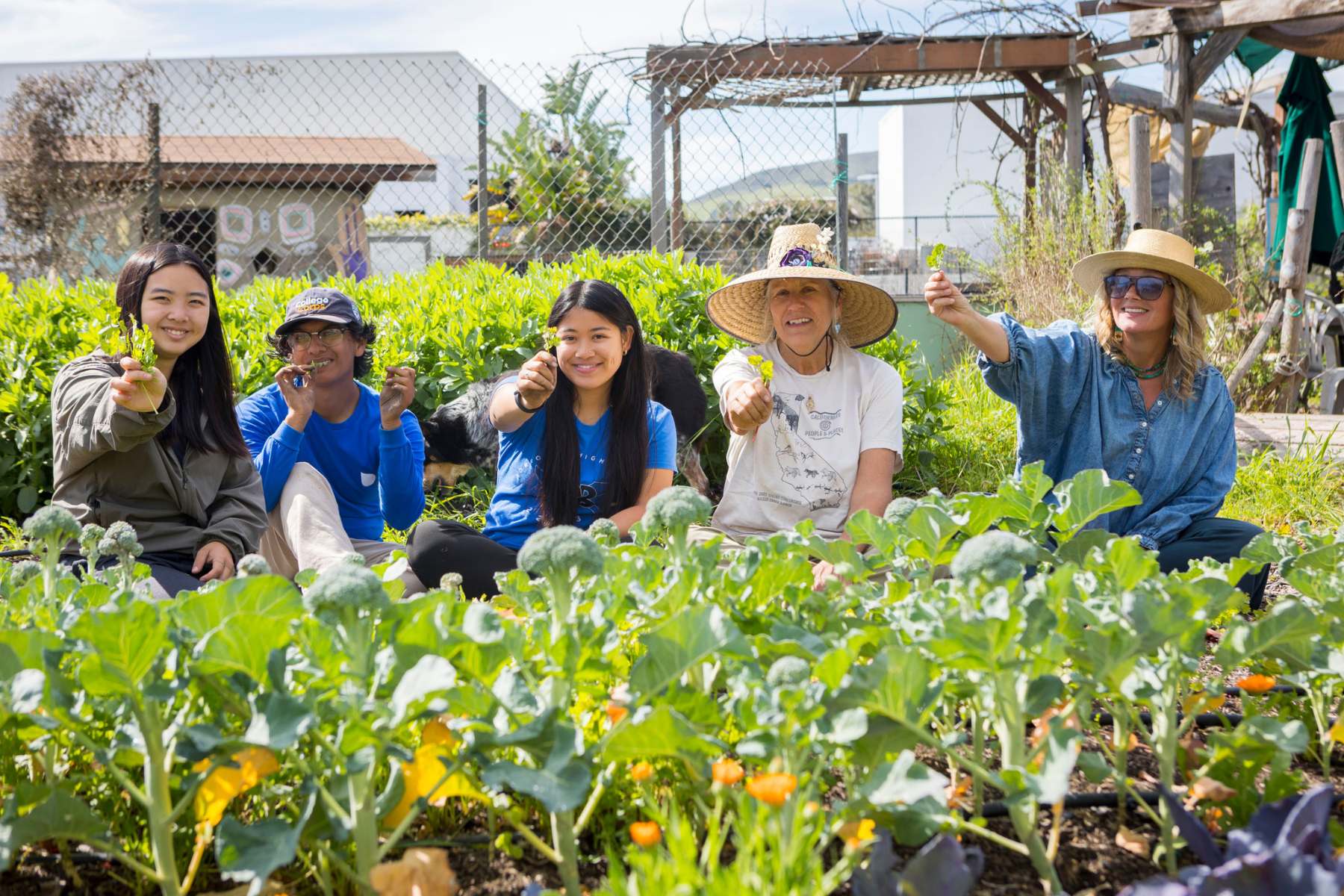
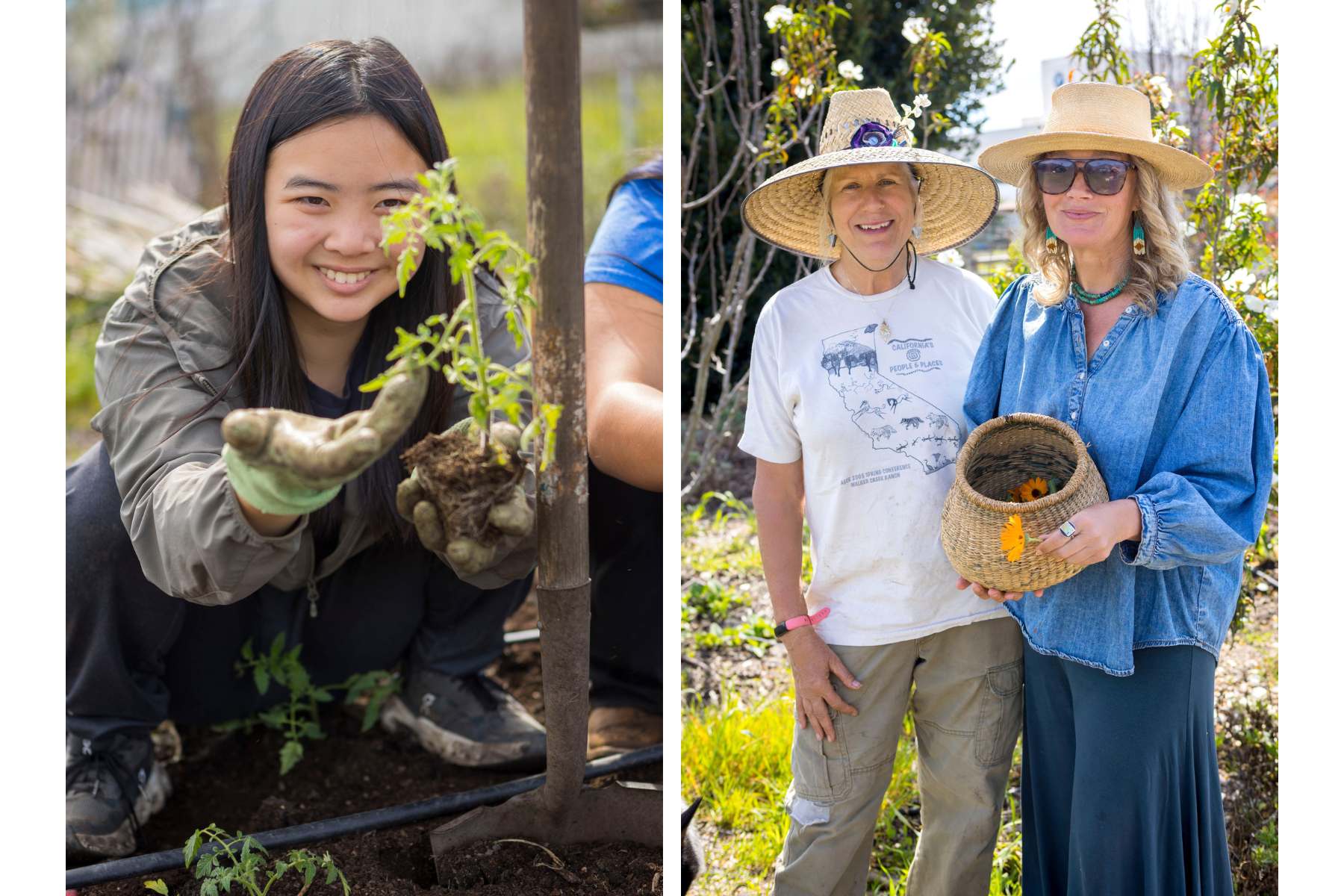
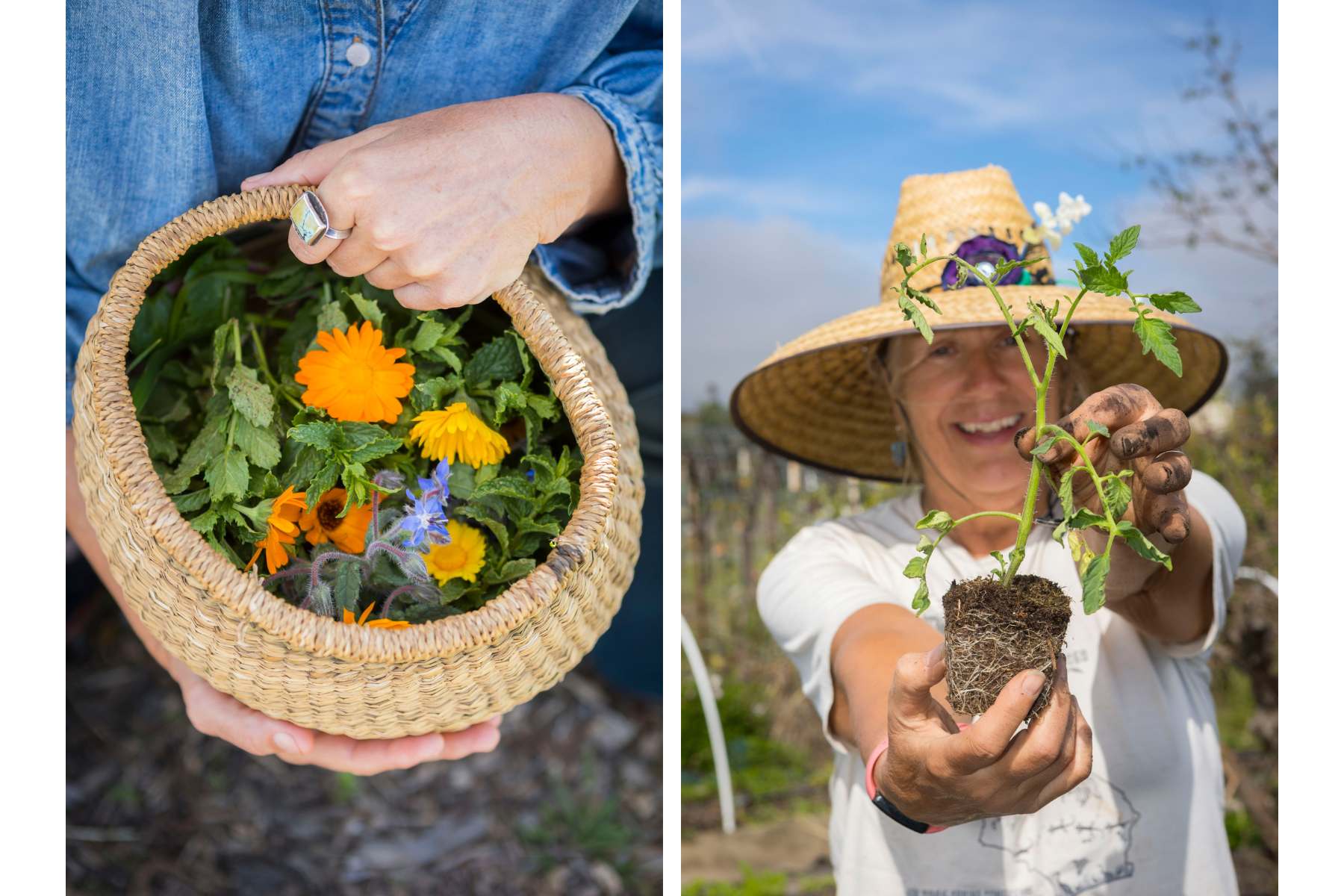
College Corps fellows from Cuesta College and Cal Poly who work on climate action, K-12 education and food insecurity, here tending to the farm. On the right, Farm leader Teresa Lees with resident herbalist Angela North.
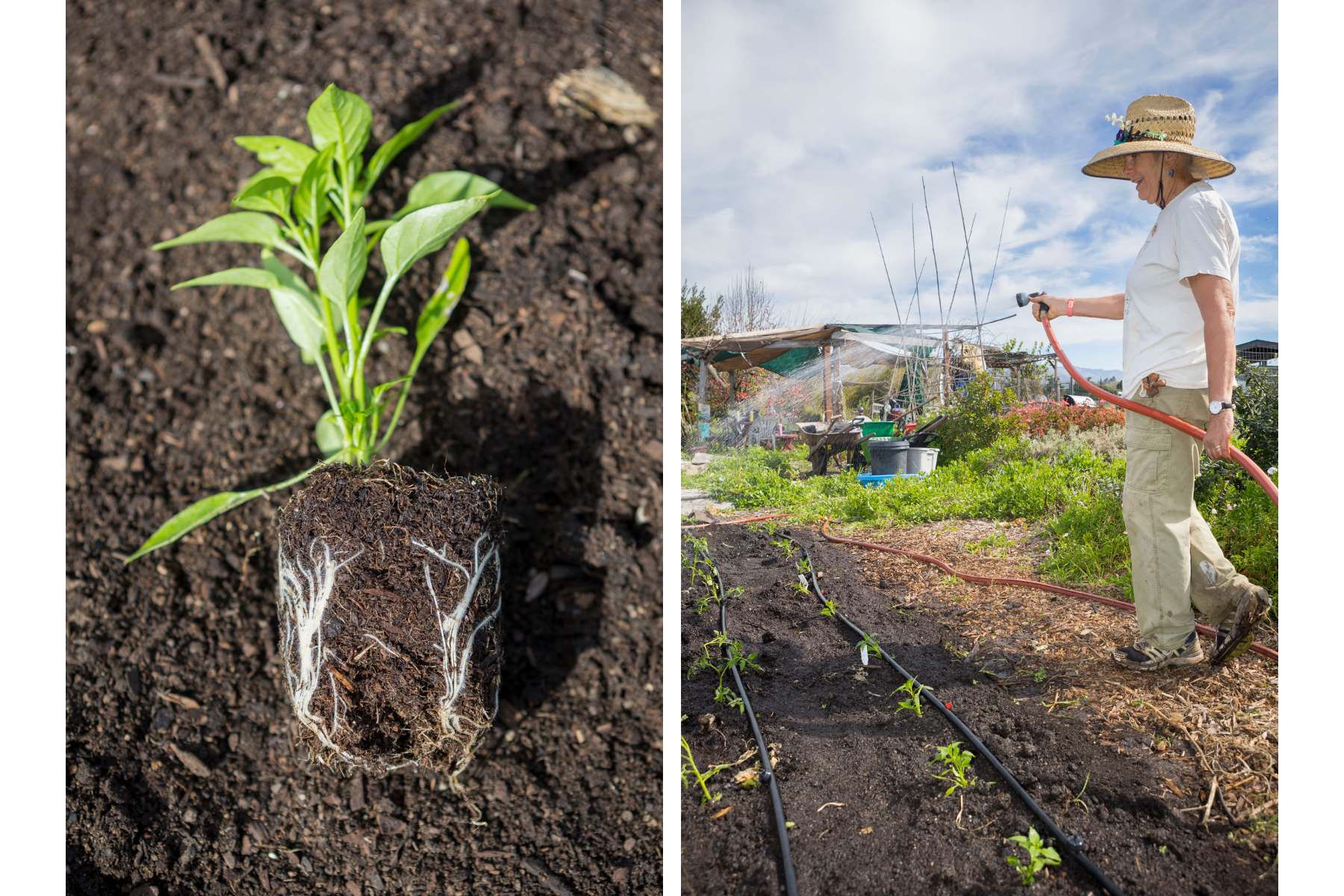
At the heart of the farm is permaculture, a philosophy Tree sees as far bigger than agriculture. “We want to get across that permaculture is a whole way of organizing society that is ethics based,” she says. “It’s not just gardening. It’s how you grow your food, collect and store water, gather and store energy, and treat your community.”
For Tree, permaculture is also about connection. “It’s literally the blending of permanent and culture,” she explains. “It’s about building community in your town and neighborhood — looking out for one another and sharing what you can.”
Farming in the city comes with challenges. The farm sits alongside the noisy freeway and commercial development and, like many urban spaces, it occasionally experiences theft and nearby encampments. But Tree says the greatest challenge is visibility: simply letting people know the farm exists.
Though she benefits from being part of City Farm SLO and collaborating with other tenant farmers, Tree often operates in the middle of two agricultural worlds. “I’m kind of in between sizes,” she says. “Bigger than a backyard, but not really a big farm that has a lot to take to the farmers market.”
Keeping the farm thriving depends on community. Volunteers — some who return year after year — help with planting, weeding and maintenance during open workdays every Sunday from 9am to noon, when anyone is welcome to join.
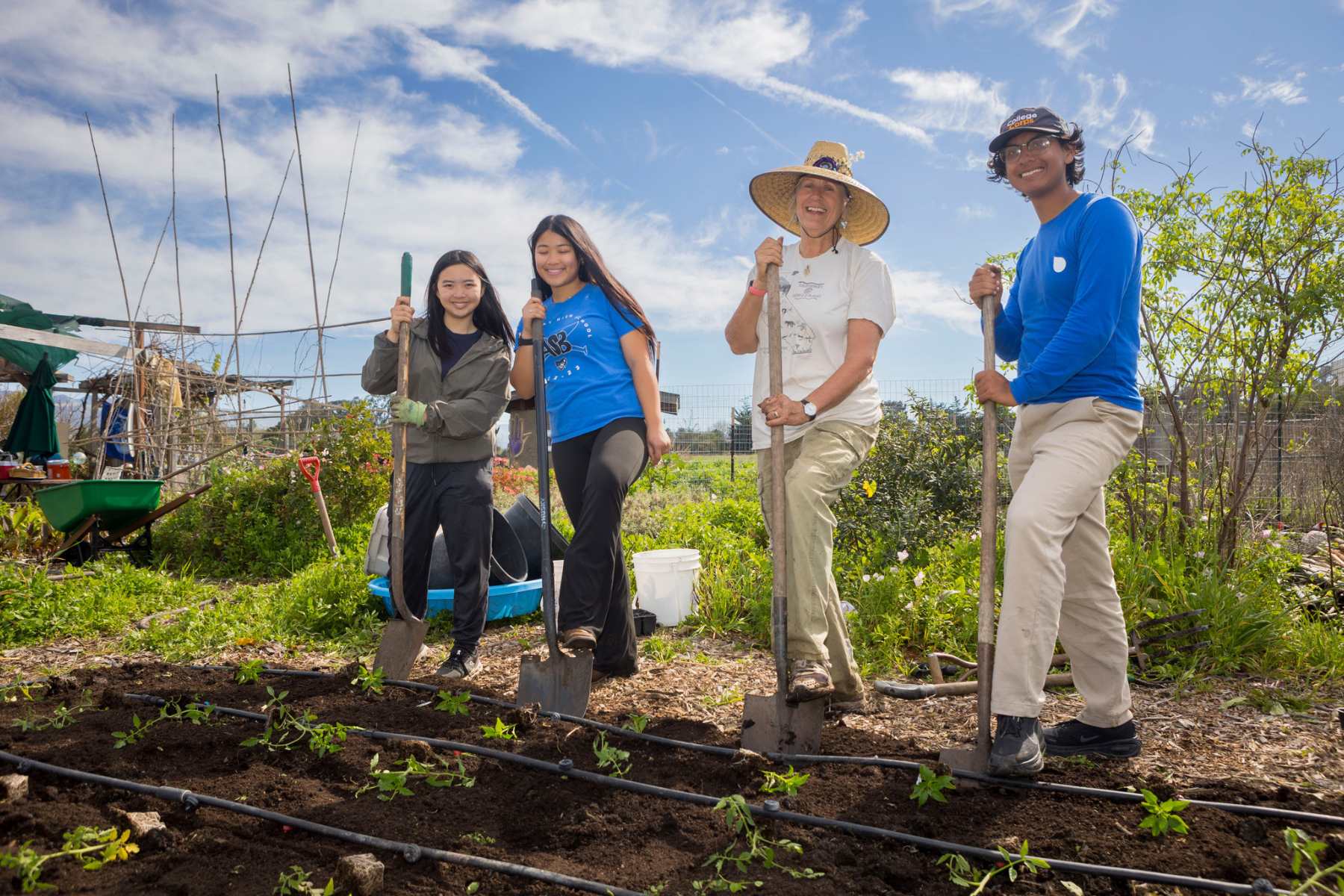
The farm is also supported by College Corps fellows from Cuesta College and Cal Poly, students who spend time learning and working alongside Tree. “I usually pair them up to work together,” she says. “While they’re working, they talk about their coursework, where they’re from, or just what movies and music they like. That’s multiculturalism, and it’s really important to me to draw that out.”
For Indie May Nelson, a Cuesta student who has been working on the farm since last August, that sense of belonging was immediate. “There’s so much support and everyone is super inclusive,” she says, adding that she was struck by the volume grown in such a small space.
Through hands-on workshops from seasonal vegetable growing to herbal harvesting, Tree encourages curiosity and confidence in the garden. Keeping classes affordable, just $10 each, helps ensure those experiences remain accessible.
“I like the idea that we’re in the city, to show an example of something people could do at home in juxtaposition to car dealerships and box stores,” Tree says.
College Corps fellows Alyssa, Indie, Angie, and Saul tackle seasonal projects.
Not all learning happens with soil underfoot.
“I want to attract the crowd of people who are interested in holistic living, health consciousness and sustainability,” says Tree. One Sunday afternoon, as volunteers wrap up their work, Rita Morris arrives to teach a Qigong class. Rooted in ancient practices of observing nature, the class is held in the Asian section of the farm. “It’s a good fit,” Tree says. “And it brings a new community of people out to experience the space.”
The farm also comes alive each month during multicultural potlucks, held on the third Sunday and open to all. Each gathering centers on a different cultural celebration — from Lunar New Year to Sukkot to Native American Heritage Month — with participants encouraged to bring a relevant dish to share.
As Tree prepares to retire from her full-time education career this year, she hopes to expand the farm’s programs and sense of belonging. “We’ve been at it for more than 10 years now, and we’re still building the community hub. We’re going to share traditions, food culture and plant knowledge to build the world we want.”