
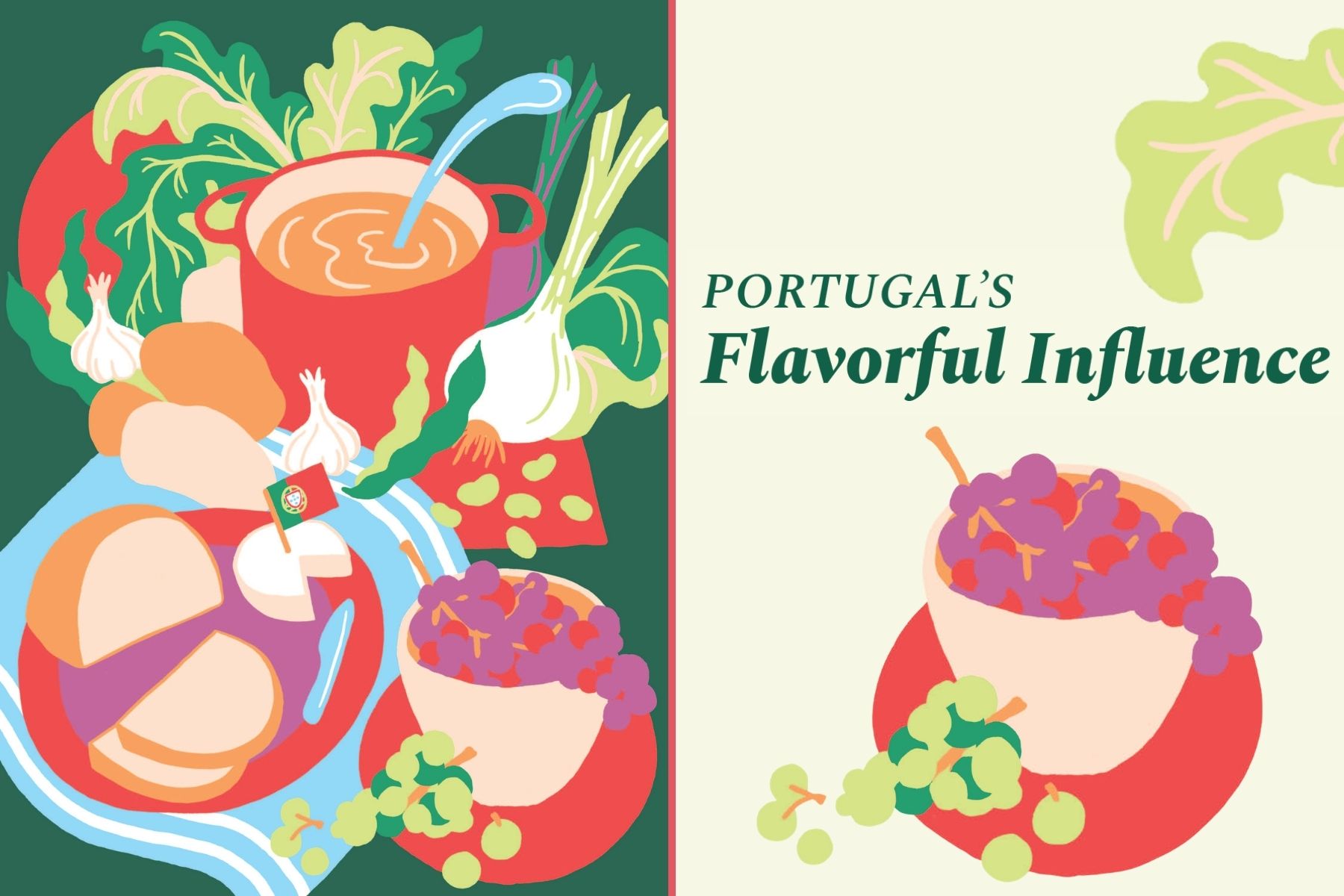
Portugal’s Influence on SLO County
Story by Jonathan LaFerrara
Illustration by Maggie Johnson
In Portuguese cuisine, rustic doesn’t mean basic. Traditional meat stews, bacalhau (salt cod) and smoked sausages made from leftover cuts are elemental, yes, but also fragrant and nuanced. Portugal is bordered by Spain and the Atlantic Ocean, both of which heavily influence its food. And thousands of miles away, that influence can be found here on the Central Coast.
Thanks to generations of countryside farmers and coastal fishermen, Portuguese home cooking has been a riff on whatever local farmers or fishers brought in each day. Inland communities relied on stews, preserved meats, beans and bread. Along the coast, there was an abundance of seafood, making cod, sardines, shellfish and octopus staples of meals. Garlic and fresh herbs are most often used to brighten dishes, though a typical Portuguese pantry includes dry goods of colorau (paprika), bay leaves, piri-piri (chili) and cinnamon.
Ercilia Martins, Co-owner of Monarch Grove Winery in Grover Beach, immigrated in the 1970s, during a period when many Portuguese families were leaving home. Economic hardship had taken hold of daily life across Portugal and the Azores, a Portuguese archipelago in the Atlantic, and families sought more stable futures elsewhere, especially in the United States, Canada, and parts of Africa.
“I was 5½ when we arrived in the U.S.,” Ercilia recalls, having grown up in Terceira, one of the islands of the Azores, known for its lush greenery and nearly tropical conditions.
“Life there was very different — it was focused on culture and community,” she recalls. “That environment left a lasting impression on me.” She maintains a very traditional lifestyle; Portuguese is still spoken at home by her parents, and even at 80 years old, her father continues to grow many of the ingredients essential to the family’s cooking: fava beans, couves (collard greens, for soup), onions, potatoes, garlic and grapes, and tends to his fruit trees.
“Food has always been central to our family life,” Ercilia says. “It’s a part of who I am.” The flavors of the Azores fill her kitchen through homemade soups, slow-roasted meats in traditional clay pots, and the many desserts, pastéis de nata included. She speaks fondly of fresh cheeses made at home, especially the soft cheese her mother prepares, enjoyed alongside Portuguese sweet bread massa sovada.
Winemaking, too, runs deep in her family history. “Both here and in Portugal and the Azores, my family has made wine for generations.”
Thomas Darosa, Co-owner of SLO De Vie Distillery in Grover Beach, followed a similar path. Also born in the Azores islands before moving to Artesia, a Los Angeles-area community where many Portuguese immigrants settled, he grew up immersed in customary practices. “An important part of our lifestyle is home-cooked traditional food, homemade wine and spirits called aguardente,” he says.
“Every uncle was proud to show his private cellar,” Thomas recalls, which were likely stocked with a barrel of wine intended to last throughout the year. And “oftentimes oxidized along the way,” he jokes. After pressing grapes for wine, whatever remained was commonly distilled into homemade aguardente.
This was the inspiration behind his distillery, which he co-founded with his partner Anatoly Rosinsky in 2017. SLO De Vie produces both aged and unaged aguardente, along with vodka, gin and distinctive Portuguese-inspired spirits flavored with passion fruit, anise and fig.
“We build upon Old-World ways of distilling, with the addition of our own California twist,” he explains. “After all, one has to express himself.”
For many Portuguese families, homemade wine was not a casual hobby — it was part of daily life. Judy Aron, Founder of AronHill Vineyards in Templeton, feels this connection. Portuguese culture came through Judy’s mother’s side of the family, who emigrated from Pico Island in the Azores, where they were farmers, primarily working with dairy and grapes.
“Food and wine were simply part of everyday life for them,” says Judy, who runs the winery alongside her daughter Kathryn.
Though not a Portugal native herself, she was immersed in its heritage through her mother’s stories, especially those centered around generosity and hospitality. “There was always an open seat,” Judy remembers, where anyone who stopped by was welcome to share a meal. This became foundational to the Bistro at AronHill, the estate winery restaurant, where the menu often includes Portuguese-influenced dishes.
“I want guests to feel welcomed and relaxed, more like gathering with friends,” she says. Visitors are encouraged to settle into conversation. Judy laughs as she explains how saying goodbye often takes a little extra time in Portugal. “There’s always one more smile, another story, and maybe just one more sip of wine,” she reflects.
She grew up watching her mother and aunts cook together, and was always amazed at the kitchen full of energy, “with lots of talking, laughing and movement all around.” There was the shucking of fava beans, making homemade kale soup with vegetables from the garden and letting beans slowly simmer on the stove. And that unmistakable smell of sweet bread baking in the oven, or sopas for special occasions.
“It was never just about the meal itself,” says Judy. “It was about sharing, and taking time to be together. It’s special to see this all still alive.”
Portugal's Heritage Days

Beyond spirits, Thomas Darosa saw an opportunity to strengthen Portuguese cultural connection in San Luis Obispo County. Four years ago, he helped launch what would become the annual Portuguese Heritage Days. With support from the Pismo Beach Chamber of Commerce and community volunteers, the free two-day event has grown into a gathering where guests sample traditional Portuguese dishes and shop imported pottery, foods, clothing and art from Portugal while enjoying live performances that range from traditional dance groups to musicians and comedians.
Contrary to the perception that Portuguese culture has a limited presence on the Central Coast, Thomas says the community here is stronger than many realize. About 5,600 people of Portuguese descent live full-time in the county, with many more maintaining second homes or traveling here regularly from larger Portuguese communities throughout California’s Central Valley.
Portuguese Heritage Days
October 9–10, 2026
390 Bello Street in Pismo Beach
Portuguese Heritage Association Pismo Beach
Pastéis de Nata (Portuguese Custard Tarts)
Recipe by Lauren Aloise, Spanish Sabores
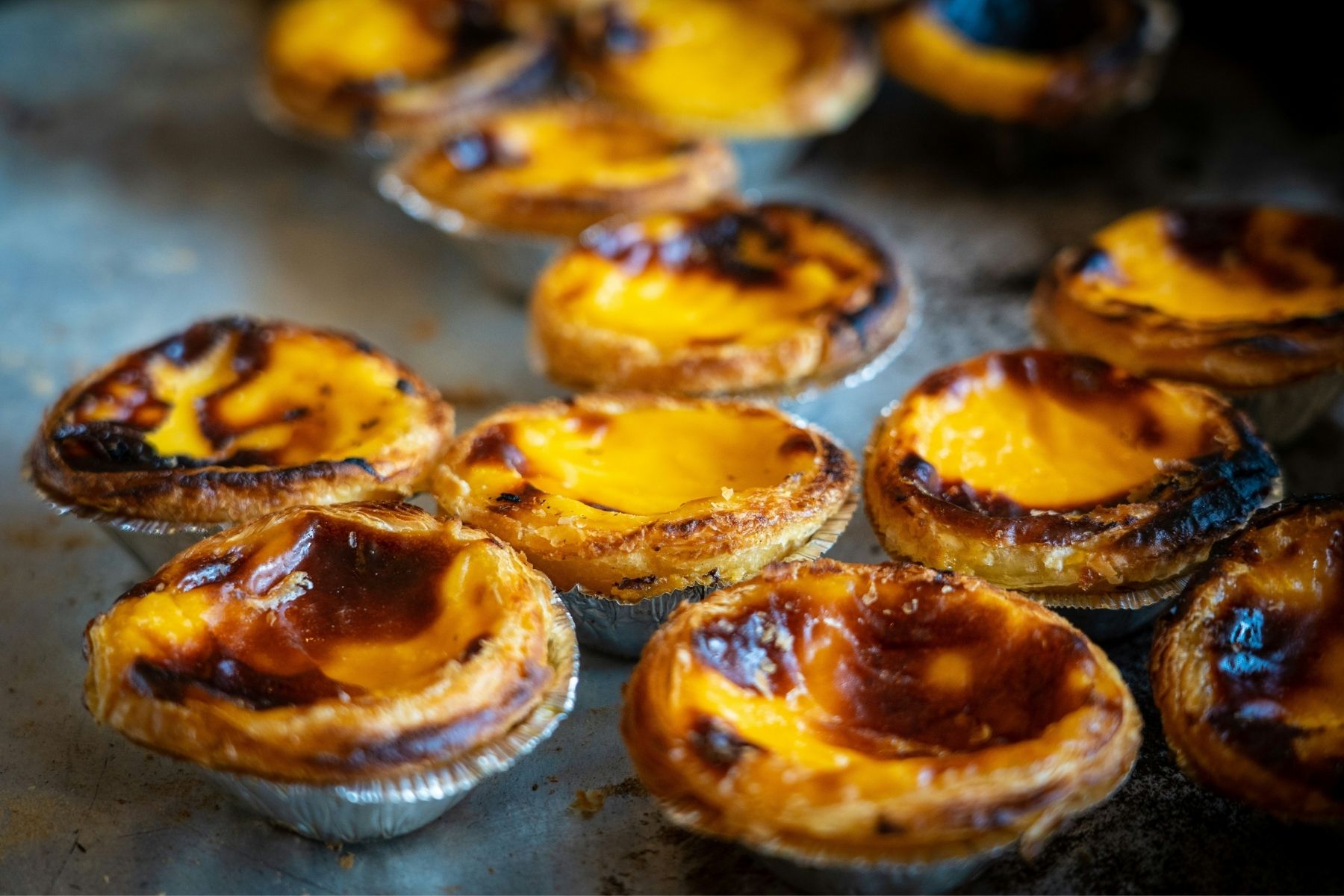
Makes 12 tarts
INGREDIENTS
- 1⅓ cups granulated sugar
- ⅓ cup water
- 1 teaspoon vanilla extract
- Peel of 1 lemon, cut in thin strips
- 1 cinnamon stick
- 1½ cups whole milk
- ⅓ cup all-purpose flour
- ¼ teaspoon salt
- 6 large egg yolks
- 1 sheet puff pastry
- Powdered sugar, for dusting (optional)
- Ground cinnamon, for dusting (optional)
PREPARATION
Step 1
Preheat oven to 550 degrees F. Lightly grease 12-cup muffin tin. In medium, heavy-based saucepan bring sugar, water, vanilla extract, lemon peel and cinnamon stick to a boil. Cook without stirring until it reaches 220 degrees F on a candy thermometer. Remove cinnamon stick and remove pan from heat.
Step 2
In separate saucepan, whisk milk, flour and salt until well blended. Whisk constantly and cook over medium heat until thickened, about 5 minutes. Remove from heat and let cool for 10 minutes. Once milk mixture has cooled, whisk in egg yolks. Add sugar syrup mixture and mix until everything is well combined. Pour through sieve into measuring cup, to remove any lumps.
Step 3
Cut puff pastry sheet into two pieces and stack. Tightly roll sheets into a log from the short side. Cut into 12 evenly sized pieces. Place one piece of pastry in each well of muffin tin. Dip your thumb in cold water, then press pastry against sides to form cup. Make sure pastry comes slightly above edge of each well. Fill each pastry cup ¾ with custard. Bake for 10 to 12 minutes. Tarts are done when custard starts to caramelize and blister and pastry turns golden brown. Dust with powdered sugar and cinnamon, if desired. Serve warm.